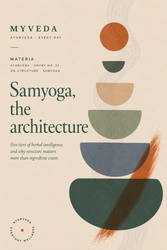
Samyoga, the architecture
Posted by MyVeda on May 17th 2026
Samyoga,
the architecture
In classical Ayurveda, a formula is not a list. It is a structure.
The word is samyoga — literally, “right combination.” It names the principle by which herbs are assembled into a working medicine. The premise is that a single herb has a known action, but several herbs in correct combination have an action greater than the sum of their actions. The combination is not additive. It is architectural.
This is the part of the tradition that does not translate easily into the modern supplement market. A typical wellness product lists its active ingredient on the front, sometimes adds two or three supporting compounds, and prices the bottle by the count and dose of the lead. Samyoga runs the other direction. The lead matters; the supporting cast matters more; the architecture matters most.
A classical formula of fifty herbs is not fifty active ingredients. It is one medicine, built in tiers, where each tier does a different job. Strip out the tiers and the medicine no longer works the way the classical text promised. The herbs remain. The intelligence does not.
|
Principle
Samyoga
“Right combination”
|
Tiers
Five
Primary to balancing
|
Across the line
12 of 12
Every MyVeda formula
|
Every formula in the MyVeda line is constructed according to the same five-tier structure. The names are simple. The work each tier does is precise.
Primary herbs. These are the leads. They carry the formula’s central action — the herbs whose names would appear if the formula had to be reduced to one line. In CalmVeda 23™, the primary herbs are Indian Valerian, Arjuna, Brahmi, and Ashwagandha. In VitalVeda 46™ — the principal rasayana — they are Amla, Brahmi, Velvet Bean, Chebulic Myrobalan, Asparagus adscendens, Curculigo, Arjuna, and Ashwagandha. The primary tier is where the formula declares itself.
Supporting herbs. These stabilise and extend the primaries. They do not lead. They surround. Where a primary herb has a sharp action — Arjuna for the heart, Brahmi for manas — the supporting tier ensures the action lands cleanly, without overshoot. Shatavari in CalmVeda 23™ supports the nervous system substrate that Indian Valerian acts on; Vanilla soothes the agitation that the primaries are working to settle.
Bio-available herbs. These are the carriers. The classical understanding is that no herb works if the body cannot absorb it. Ginger, Long Pepper, Black Pepper, Cardamom — the warming spices — open the srotas, the channels of the body, and ensure the formula’s intelligence reaches the tissues it is meant to address. Without this tier, the primaries are intelligent but inaccessible.
Co-factors. These are the specialists. Mineral preparations, prepared pearls, classical bhasmas, and the deep-channel herbs that act on subtle layers the primaries cannot reach. Mukta pishti in CalmVeda 23™ sits here — not a lead, but a specialist co-factor that cools the pitta component of worry. Dashamoola, the ten-root blend, sits here too. The co-factor tier is where the classical tradition shows its specificity.
Balancing herbs. These are the anchor. They appear at the formula’s close, ensuring that whatever the primaries do is held in tridoshic equilibrium. Ashwagandha and Shatavari appear in this tier across multiple MyVeda formulas. Their job is not to add a new action. Their job is to keep the formula from tipping.
Five tiers. One medicine. The architecture is the same across every formula in the line; only the herbs in each tier change to meet the named indication.
It is the visible trace of an invisible structure.
A modern reader sees “twenty-three herbs” or “forty-six herbs” or “seventy-six herbs” on a MyVeda label and reasonably asks what those numbers mean. The honest answer is that the count is a consequence of the architecture, not the point of it.
CalmVeda 23™ contains twenty-three herbs because that is what the five-tier structure required to address worry in the classical way: four primaries to lead, two supporting, three bio-available, two co-factors, two balancing, plus the supporting members of Dashamoola. The number is not chosen for marketing. It is what the architecture asked for.
VitalVeda 46™ contains forty-six herbs because rasayana — full-spectrum rejuvenation across the seven dhatus — needs more leads, more supporting cast, more channel-openers, and more co-factors than a single-indication formula. The number reflects the breadth of the task.
ImmuneVeda 76™ contains seventy-six because immunity, in classical reading, is layered work: natural immunity, acquired immunity, seasonal immunity, plus the prana-supporting respiratory layer. Each layer needs its own primaries, supporting tier, and co-factors. The architecture grows to meet the indication.
There is a question that follows from all this: why bother? Why not simply formulate around three or four herbs at high dose, the way most supplements do?
The classical answer is that single-herb or low-count formulas address single indications cleanly, and not much else. They work, but narrowly. The body that takes a high-dose Ashwagandha capsule receives Ashwagandha’s action — adaptogenic support, stress resilience. The body that takes a samyoga formula in which Ashwagandha sits as a primary herb among twenty-two others receives Ashwagandha’s action plus the architecture’s wider work: the supporting tier that prevents overshoot, the bio-available tier that opens the channels, the co-factors that reach the layers Ashwagandha alone cannot reach, the balancing tier that holds the dose in equilibrium.
The price of single-herb dosing is the absence of architecture. The price of architecture is more herbs, more sourcing, more formulation work, and a longer ingredient list. The classical tradition decided the architecture was worth the price. MyVeda’s formulas follow that decision.
This is also what samyoga protects against in clinical practice. A formula built only on leads can push too hard in one direction; the body compensates, and the formula’s benefit is eaten by the compensation. A formula built with the full architecture moves more slowly but more cleanly. The work it does on the surface is not paid for by the depth.
Slow medicine, in the literal sense. Built to be taken across years rather than weeks. The architecture is what makes that possible.
What this means, practically, is that every product in the MyVeda line is built the same way. The herbs change. The architecture does not.
A customer who reads the samyoga section on the CalmVeda 23™ product page is reading the same five-tier structure as the customer reading VitalVeda 46™, GutVeda 55™, ImmuneVeda 76™, or any of the others. The names of the herbs in each tier shift to match the named indication, but the tiers themselves are constant: primary, supporting, bio-available, co-factor, balancing.
This is not an aesthetic decision. It is a fidelity choice. The classical formulations the MyVeda line is built on — Chyawanprash, Triphala, Dashamoola, the various kalpas and rasayanas — are themselves samyoga constructions. To formulate without the architecture would be to use the herbs of the tradition without using the tradition itself.
Three entries in. Mukta pishti was one preparation, in one formula. Arjuna was one herb, across six. Samyoga is the structure that holds both stories. It is the through-line of every formula in the line, and the reason — if there is one reason — that MyVeda exists as a brand at all.
The herbs are old. The architecture is older. The formulas are an attempt to carry both forward, without simplification, into the kind of bottle a customer can reasonably keep on a shelf.
|
Entry No. 01
On mukta pishti and the lineage of Vaidya V.M. Dwivedi.
|
Entry No. 02
The bark Charaka called hridya, across six MyVeda formulas.
|